
Citizenship test guide
American flag history: how it grew from 13 stars to 50, and the people behind it
The flag has changed many times as the country grew. See each design, meet the people who made, flew and raised it, including immigrants, and practice the citizenship test questions about the flag.
Start practicing →The flag, design by design
1777: The first Stars and Stripes
13 stars, 13 stripes
On June 14, 1777, Congress decided that the flag would have thirteen stripes, alternating red and white, and thirteen white stars on a blue field. The stars stood for a new nation among the nations of the world. Congress did not say how to arrange the stars, so early flags had stars in circles, in rows and in other patterns.
Smithsonian: Broad Stripes, Bright Stars, and White Lies1795: Fifteen stars and fifteen stripes
15 stars, 15 stripes
Vermont and Kentucky joined the Union, and Congress added a star and a stripe for each. This is the flag that flew over Fort McHenry in 1814, when Francis Scott Key wrote the words of the national anthem. Its stars and stripes were each about two feet wide.
National Park Service: Mary Pickersgill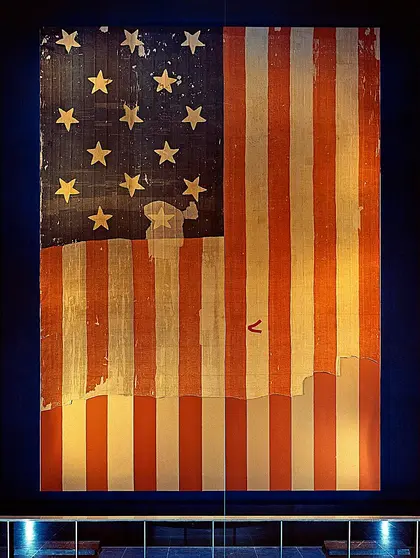
The Fort McHenry flag at the Smithsonian, about 1964. Smithsonian Institution Archives. 1818: Back to thirteen stripes
20 stars, 13 stripes
In 1818 Congress went back to thirteen stripes, for the original colonies, and set a rule that is still used: when a new state joins, one star is added to the flag on the next July 4.
US Code, title 4, section 2: adding a star1912: Forty-eight stars
48 stars, 13 stripes
New Mexico and Arizona became states in 1912. The flag had forty-eight stars, in six rows of eight, for the next 47 years.
US Code, title 4, section 1: the flag1959: Forty-nine stars
49 stars, 13 stripes
Alaska became a state on January 3, 1959. President Eisenhower signed an order for a 49-star flag the same day. It was raised at Fort McHenry on July 4, 1959.
Eisenhower Presidential Library: design of the 49- and 50-star flags1960: Fifty stars
50 stars, 13 stripes
Hawaii became a state on August 21, 1959. More than 3,000 people sent in ideas for a 50-star flag. The design in use today was ordered by President Eisenhower and first raised at Fort McHenry on July 4, 1960.
Eisenhower Presidential Library: design of the 49- and 50-star flags
The small flags are drawings to show how the design grew. They are not exact copies of the official star patterns.
The people behind the flag
These are the people who designed, sewed, flew and raised the flag. Some of the best known stories are not fully proven, and we say so. Two of the people were immigrants.
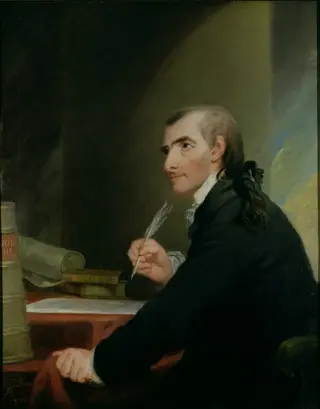
Francis Hopkinson, by Robert Edge Pine, 1785. Historical Society of Pennsylvania. Francis Hopkinson
Signer of the Declaration of Independence
Hopkinson was a member of the Continental Congress and worked for the Navy. He sent Congress a bill for his work on the design of the stars, and the bill is in the National Archives. Historians think he was responsible for the stars, but there are no records of how the design was chosen.
Betsy Ross
Philadelphia flag maker
Betsy Ross made flags for about 50 years. A popular story says she made the first Stars and Stripes. Her grandson told this story in 1870, and historians have found no proof that it is true. The Smithsonian notes that the story remains one of the best loved in American history.
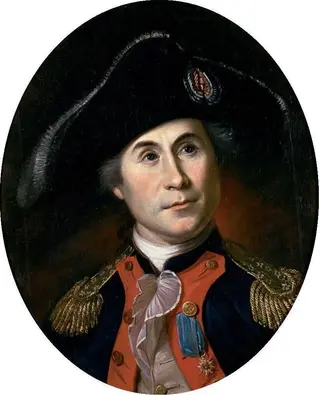
John Paul Jones, by Charles Willson Peale, about 1781. Independence National Historical Park. John Paul Jones
Naval officer, born in Scotland
John Paul Jones was born in Scotland in 1747 and became a captain in the American navy. On June 14, 1777, the same day Congress chose the flag's design, it ordered him to command the ship Ranger. The Navy says he hoisted the new flag on Ranger. In February 1778 a French fleet saluted the Ranger's flag, and many accounts call this the first salute to the flag by a foreign country. A Navy library note says a Dutch governor may have saluted an American ship earlier.
Naval History and Heritage Command: salute to the flag, 1778
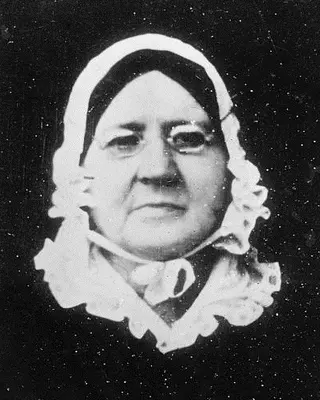
Mary Young Pickersgill. Library of Congress. Mary Pickersgill and the women who sewed the Fort McHenry flag
Baltimore flag makers, 1813
Major George Armistead, who led Fort McHenry, asked Mary Pickersgill to make a huge flag. She worked with her daughter, two nieces and a 13-year-old African American indentured servant named Grace Wisher. The flag was 30 feet by 42 feet. The National Park Service also notes that Pickersgill herself held enslaved people.
Robert Heft
High school student, Ohio
In 1958 Robert Heft, a 17-year-old in Lancaster, Ohio, made a 50-star flag as a class project, before Alaska and Hawaii were states. His teacher gave it a B minus. The Library of Congress says the teacher promised a higher grade if Congress accepted the design, and that Congress did in 1960. The Smithsonian's Postal Museum credits Heft with the layout of the 50-star flag.
Michael Strank
Marine sergeant, born in Czechoslovakia
The National Park Service lists Michael Strank as an Ellis Island immigrant who was born in Czechoslovakia in 1919. He led the squad of Marines that raised the flag on Mount Suribachi on Iwo Jima in February 1945, in the famous photograph by Joe Rosenthal. He was killed on the island a few days later. Some Marine Corps accounts say he was born in Pennsylvania to parents from Czechoslovakia, so sources differ about his birthplace.
Read about other immigrants in the history of immigration to the United States. The flag also appears in the Pledge of Allegiance and in the national anthem.
Citizenship test questions on this topic
These civics test questions are about the flag, the Pledge and the anthem. Each one links to the answers USCIS accepts.
- Why does the flag have 13 stripes?
- Why does the flag have 50 stars?
- What do we show loyalty to when we say the Pledge of Allegiance?
- What is the name of the national anthem?
WelcomeOath asks every question out loud and brings back the ones you still miss. The first three lessons are free. See all 128 questions.
Questions people ask
Why does the American flag have 13 stripes and 50 stars?
The 13 stripes stand for the 13 original colonies that became the first states. The 50 stars stand for the 50 states today. These are two of the questions on the citizenship civics test.
Who designed the first American flag?
No one knows for sure. Congress chose the design on June 14, 1777. Historians think Francis Hopkinson, a signer of the Declaration of Independence, was responsible for the stars. The story that Betsy Ross made the first flag has no proof.
How many times has the flag changed?
The number of stars changed each time new states joined. After the 1818 law, one star is added on the July 4 after a new state joins. The 50-star flag has been used since July 4, 1960.
Who sewed the flag that inspired the national anthem?
Mary Pickersgill, a Baltimore flag maker, sewed it in 1813 with her daughter, two nieces and Grace Wisher, a 13-year-old African American indentured servant.
Were any people behind the flag immigrants?
Yes. John Paul Jones, born in Scotland, hoisted the new flag on the ship Ranger in 1777. Michael Strank, an immigrant from Czechoslovakia, led the Marines who raised the flag on Iwo Jima in 1945.
From welcome to oath
Let's get you ready
Becoming an American is something to celebrate. Practice out loud, and we will help you feel ready for the interview.
Start practicing →